

This blog post will show you how to master your audio to an exact true peak and LUFS measurement. LUFS and True Peak affect each other and therefore should be addressed simultaneously.
There is a relationship between LU (loudness units) and dB (decibels) that gives an easy formula to help you hit your target levels with precision. To put it simply, 1 LU = 1 dB. So if your master has a reading of -12.3 LUFS int (integrated), and your target is -14 LUFS int, then you would need to reduce the gain of the master by the difference, so 1.7dB (-12.3 + -1.7 = -14). I would recommend reducing a plugin on your master chain that increases gain by this amount (1.7 in this case), such as the gain on your limiter. If your master was too quiet with a reading of -20.1 LUFS int, you would need to increase the gain by 6.1dB to hit -14LUFS int.

Note: The LUFS:dB relationship becomes less consistent as the loudness increases. A 1dB gain increase of a track measuring -7 LUFS int might give you an increase of around 0.5 LUFS Int. At this loudness, the limiter reacts less transparently to the audio.
Your true peak target can be achieved with a similar approach. Though rather than adjusting the gain, we’re going to adjust the output on the limiter. If your target is -1.0dBTP (as is the recommendation for streaming services) but your track is peaking at -0.23dBTP, then you would need to reduce your output by 0.77dB. This will give you your -1.0dBTP target but will also reduce your integrated LUFS by 0.77, so you will need to increase the gain to compensate.

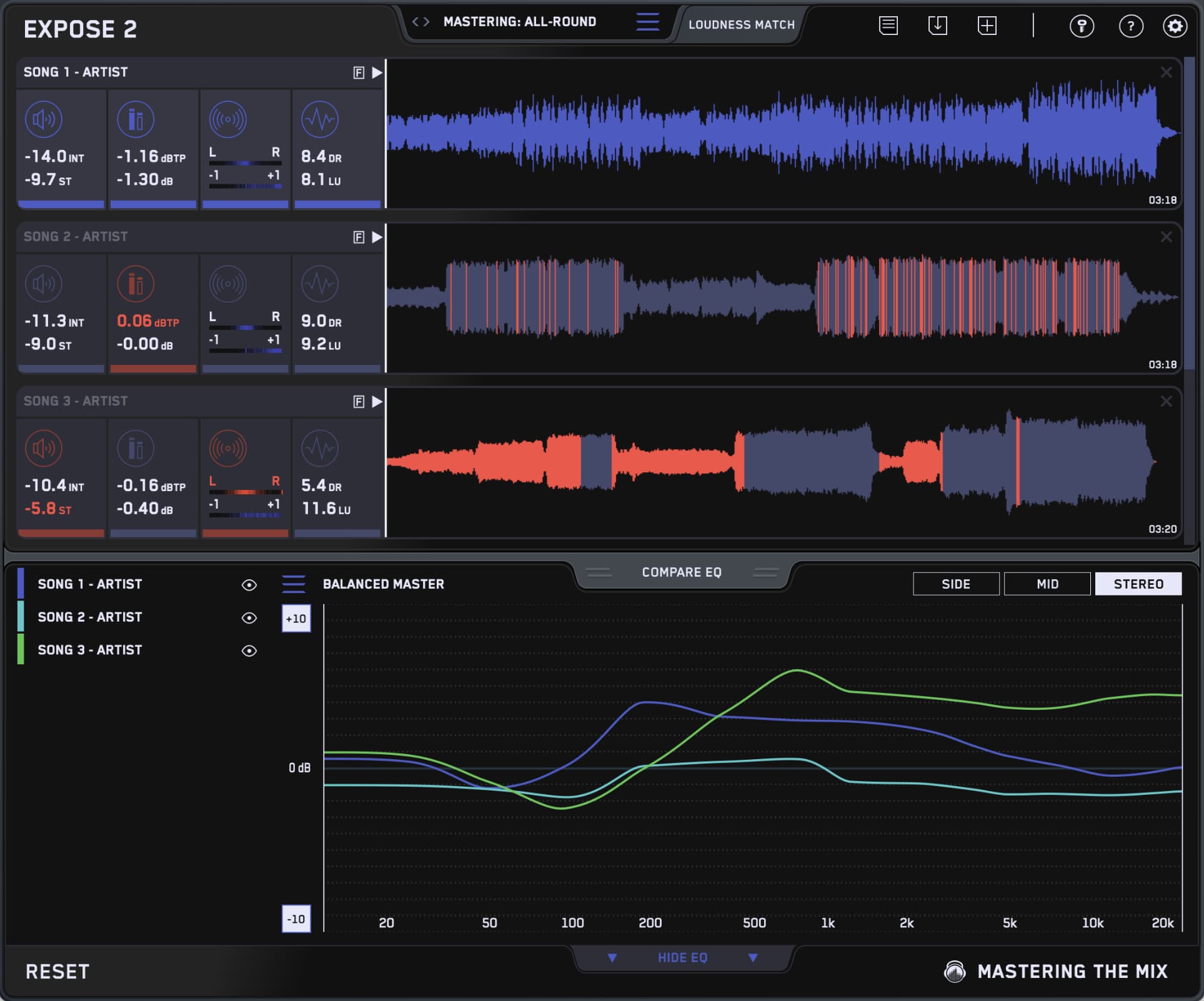
I recommend using a metering plugin such as LEVELS to help you get your readings as close as possible to your targets, then run your bounce through EXPOSE to get the technical summary in seconds. From here you can make any adjustments you feel are needed.
It’s not always necessary to hit your targets with this kind of precision, but knowing the formula gives you a greater mastery over your music and may help you be more efficient in the studio.
Frequently Asked Questions
What is the relationship between LUFS and dB?
To keep it simple, 1 LU equals 1 dB. So if your master reads -12.3 LUFS integrated and your target is -14, reduce the gain by the 1.7 dB difference. If it read -20.1 LUFS, you would increase gain by 6.1 dB to reach -14 LUFS.
How do you hit an exact true peak target?
Adjust the limiter output rather than the gain. If your target is -1.0 dBTP but the track peaks at -0.23, reduce the output by 0.77 dB. This also lowers integrated LUFS by 0.77, so increase the gain to compensate and keep both readings on target.
Does the LUFS to dB formula stay accurate at high loudness?
No. The relationship becomes less consistent as loudness rises. A 1 dB gain increase on a track measuring -7 LUFS integrated might only add around 0.5 LUFS, because at that loudness the limiter reacts less transparently to the audio.
Why address LUFS and true peak at the same time?
LUFS and true peak affect each other, so changing one shifts the other. Reducing the limiter output to hit a true peak target also lowers integrated LUFS, which then needs gain compensation. Treating them together lets you hit both targets precisely and work more efficiently.