

How should you master your track in 2026?
Instead of guessing, I analysed the most-streamed songs on Spotify in 2025 using EXPOSE 2 to see what’s actually working at the very top level.
In this post, I break down the real mastering data from the 15 biggest tracks of the year, showing you how loud, dynamic, and balanced today’s most successful music really is, and what that means for your own tracks.
TLDR:
- Max short-term loudness: –6 to –7 LUFS Loud without crushing the track.
- DR: 5–6.5 Punchy but controlled.
- Loudness range: 5–9 LU Enough movement to feel alive.
- Transients: Shaped to suit the vibe, not flattened by default.
- Tonal balance: No universal curve. Gracie Abrams – That’s So True sits right in the middle of the top 15, making it a solid, well-balanced reference.
This post focuses on analysis. If you want to learn how to actually master a track, check out this blog post.
#1 Most Streamed Song On Spotify 2025

When I analysed Die With A Smile using EXPOSE 2, what stood out wasn’t extreme loudness, it was how dynamic the master is.
The track maxes out at 7.1 dynamic range (DR), which is a strong indicator of punch and transient clarity. As a rough guide:
- Squashed masters tend to sit at 4DR or below
- Compressed masters around 4.1 to 5DR
- Transient masters between 5.1 and 6,
- Anything above 6DR is very punchy.
At over 7, this record allows drums, accents, and choruses to genuinely hit instead of being flattened.
The loudness range of 10.4 LU reinforces this even further. Anything above 6 LU is considered very dynamic, meaning the track moves noticeably between sections rather than sitting at a constant intensity. For your own music, this is an important takeaway. The biggest record in the world in 2025 wasn't chasing maximum density or constant loudness. They prioritised movement, contrast, and impact, which translates into excitement, emotion, and long-term listenability.
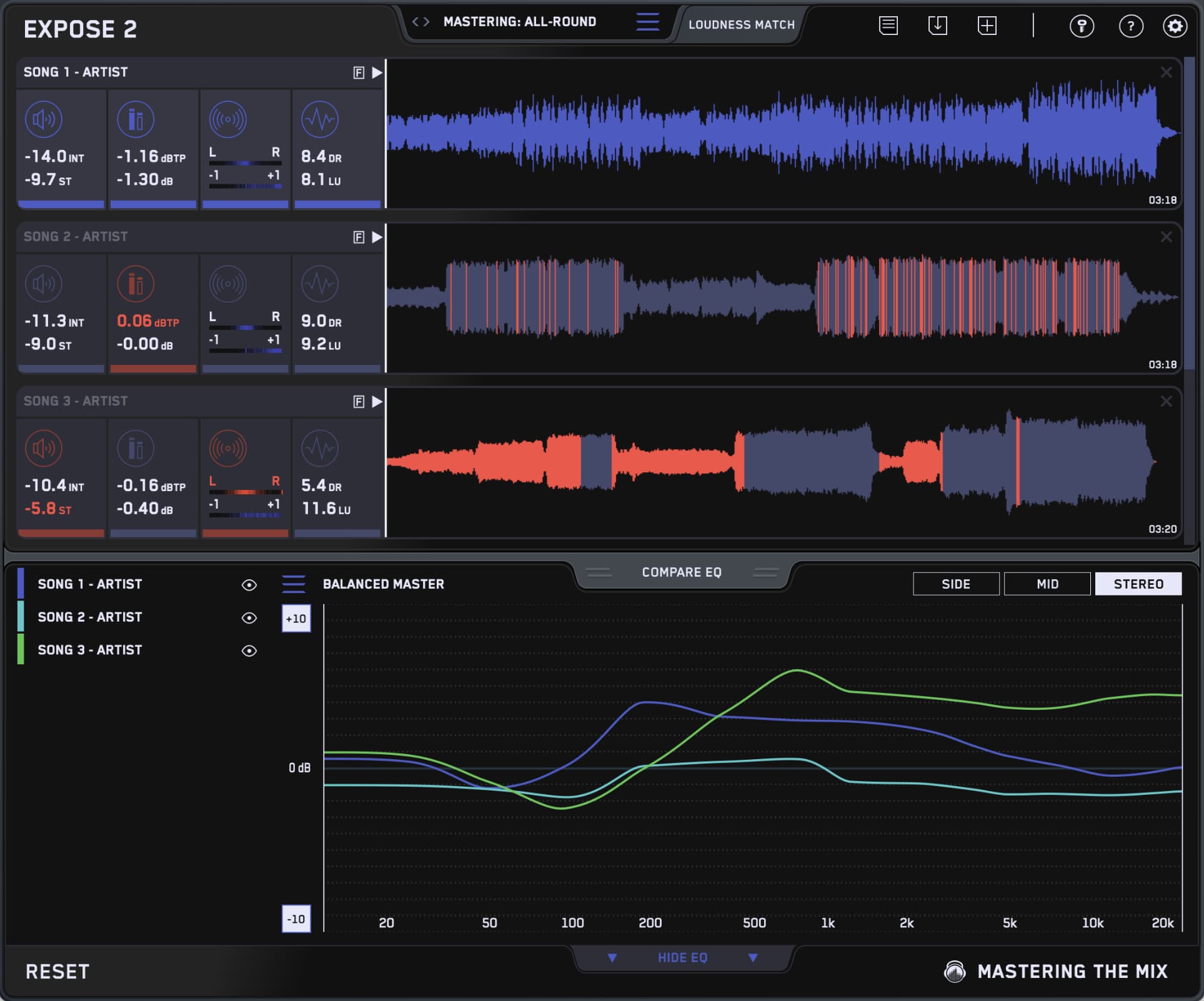
Our standalone application EXPOSE 2 makes this visible, so you can see whether your master is breathing enough to feel alive, or whether it’s being held back by over-compression.
The Compare EQ section at the bottom on EXPOSE 2 shows that the track was quite light in the low-end, very present in the 2kHz vocal range, with a more balanced high end above 10kHz. Tonal balance across tracks varies enormously, and where most tracks have been impressively bass-heavy in recent years, Die With A Smile shows you can go against the grain and have great results.
Another detail worth noting is how controlled the peaks are, even without chasing ultra-conservative limits. The maximum short-term loudness sits around –7 LUFS, which tells us the loudest moments are powerful but not excessive.
This naturally keeps true peaks from going crazy, without needing to obsess over them. And this is where it’s important to be clear. True peaks are often treated as a critical mastering metric, but in reality, they’re largely inaudible. What actually matters is whether the loudest moments feel clean, punchy, and musical.
If your short-term loudness is sensible and your dynamics are intact, true peaks tend to take care of themselves. This track is a perfect example of that mindset in action. Instead of mastering defensively, it focuses on musical impact first, using dynamics and contrast to create excitement.
For your own music, this means worrying less about microscopic peak values and more about how your loudest sections feel. If they hit hard without sounding strained or brittle, you’re almost certainly in the right place.
#2 Most Streamed Song On Spotify 2025

When analysing Birds Of A Feather in EXPOSE 2, the mastering approach is more controlled, but the philosophy stays the same.
The track sits at 6.3 DR, which is still punchy but tighter than the number one record. The transients are softened rather than explosive, matching the smoother, more hypnotic energy of the song.
The loudness range of 4.8 LU shows a more consistent intensity, creating an immersive, locked-in feel rather than dramatic section-to-section swings.
Short-term loudness peaks around –6.5 LUFS, making the track feel subjectively loud without relying on extreme dynamics.
Tonally, the Compare EQ view shows a warmer balance, with more low-end support, a smoother upper-mid presence, and a gently rolled-off top end that keeps the vocal intimate. This kind of curve is classic for Billie Eilish. You can see below how it compares to Die With A Smile. (Do this with your own music to see how it compares to other tracks!)

True peaks are intentionally kept below 0 dBTP, reinforcing the darker, more restrained aesthetic. Slightly softened transients reduce edge and harshness, prioritising control and emotional weight over sheer impact.
Two of the biggest songs in 2025 use very different dynamic profiles, yet both avoid over-compression and loudness chasing. EXPOSE 2 simply makes those creative decisions visible, so you can choose the approach that best serves your music.
#3 Most Streamed Song On Spotify 2025

When analysing APT in EXPOSE 2, the mastering shifts again, this time toward density and consistency. The track sits at 5.4 DR, placing it firmly in the transient range rather than super punchy. This translates to a tighter, more controlled punch, with less emphasis on sharp attacks and more focus on sustained energy.
The loudness range of 3.7 LU confirms this, showing very little movement between sections. The intensity stays locked almost the entire time.
This master feels louder largely because it’s more constant. Short-term loudness peaks higher than the previous tracks at -5.4 LUFS short-term, and dynamics are intentionally restrained to keep momentum high. I
In the Compare EQ view, the scale shifts to ±5 dB, which is telling in itself. Compared to the other two tracks, APT is more evenly balanced across the spectrum, with fewer extreme tonal moves and a smoother overall contour.
Seen alongside the top two tracks, APT completes the picture. Three massive songs, three different tonal approaches. One leans into contrast, one into control, and one into consistency.

#4 Most Streamed Song On Spotify 2025

When analysing Ordinary in EXPOSE 2, this is the first track in the list that clearly prioritises density over punch. The dynamic range drops to 3.3 DR, placing it firmly in the squashed category. Transients are heavily controlled, which creates a very solid, upfront sound but leaves little room for impact to grow between sections.
Interestingly, the loudness range is still relatively high at 9.2 LU, meaning the track relies on arrangement and level changes rather than transient punch to create movement. Short-term loudness peaks at an eye-watering –3.3 LUFS, making this the loudest track so far, even though it’s the least dynamic.
In the Compare EQ view, Ordinary leans heavily into the midrange, especially around the vocal presence area, with a broad, confident curve that keeps the vocal front and centre. Compared to the other top tracks, this master is less about contrast or restraint and more about immediacy and emotional intensity.
Seen alongside the top three, this completes the picture. In 2025, there isn’t one “correct” mastering style at the top of streaming charts. Some tracks breathe, some flow, and some hit relentlessly. EXPOSE 2 simply shows you which trade-offs are being made, so you can decide which ones serve your music best.

#5 Most Streamed Song on Spotify 2025

When analysing DtMF in EXPOSE 2, the mastering sits somewhere between restraint and density. The track measures 4.6 DR, putting it on the compressed side of the spectrum, but not fully squashed. Transients are clearly controlled, allowing the groove and low-end to stay solid and consistent without feeling overly aggressive.
What stands out is the loudness range of 9.2 LU, which shows that movement comes more from arrangement and energy shifts than from transient punch. This creates a sense of dynamics without sharp attacks, which works well for a track built around rhythm, feel, and repetition rather than impact hits.
In the Compare EQ view, DtMF leans heavily into the low mids and upper bass, with a strong presence lift that keeps the vocal upfront while the top end stays relatively smooth. Compared to the other top tracks, this is one of the fullest and warmest tonal balances in the list.

Taken together, the top five streamed songs of 2025 show a clear pattern. There’s no single loudness or dynamic target. Some tracks breathe, some stay locked, and some sit right in between. What matters is that the mastering choices support the song’s intent. EXPOSE 2 simply reveals those choices clearly, so you can make them deliberately in your own music rather than copying numbers blindly.
What We See Across Tracks #6–15
By the time you get past the top five, the patterns become very clear.

Dynamics
- DR values mostly sit between 3 and 6, with only a few tracks pushing higher.
- This confirms a split trend, some records still prioritise density and loudness, others deliberately leave space for movement.
- Very low DR does not equal failure, it usually signals an emotional or stylistic choice.
Loudness Range
- Many tracks show surprisingly high loudness range, even when DR is low.
- This tells us that movement is often created through arrangement, drops, and level automation rather than transient punch.
- Dynamic interest does not always come from transients.
Short-Term Loudness
- The average loudness is -5.5 LUFS short-term.
- Tracks that feel “huge” often achieve it through consistency and sustained energy, not peaks.
- Loudness is being used as a feel tool, not a target.
Transient Handling
- Several tracks show clear transient control, sometimes aggressively.
- This is especially common in pop, hip-hop, and vocal-driven records where smoothness and vocal dominance matter more than impact.
- Softened transients are not a flaw, they’re often intentional.
Tonal Balance
- Low end varies massively across genres.
- Some tracks lean light and mid-focused, others are thick and low-mid heavy.
- There is no universal tonal curve, only curves that suit the song.

The Big Picture
There is no single mastering “standard” at the top of streaming in 2025. Successful records range from highly dynamic to heavily controlled.
The real takeaway is simple. The best-performing tracks are not chasing numbers; they’re making deliberate trade-offs.
EXPOSE 2 doesn’t tell you what your master should be. It shows you what choices are being made, so you can make your own with confidence.
Frequently Asked Questions
How loud should I master a track in 2026?
Analysis of the biggest 2025 streaming tracks points to a maximum short-term loudness of around -6 to -7 LUFS, loud without crushing the track, with an average closer to -5.5 LUFS short-term. The key is that loudness is used as a feel tool rather than a fixed target, so let the energy of the song guide it.
What dynamic range are top streaming tracks hitting?
Most sit between roughly 3 and 6.5 DR. As a rough guide, 4 DR or below is squashed, around 4 to 5 is compressed, 5 to 6 is transient and punchy, and above 6 is very punchy. There is no single correct figure; the most successful records pick a level that suits the song rather than chasing numbers.
Do I need to obsess over true peaks?
Not really. True peaks are often treated as a critical metric, but in practice they are largely inaudible. If your short-term loudness is sensible and your dynamics are intact, true peaks tend to take care of themselves. What actually matters is whether your loudest moments sound clean, punchy, and musical.
Is there a single tonal balance I should aim for?
No. Across the biggest tracks, low-end and tonal balance vary enormously, from light and mid-focused to thick and low-mid heavy. There is no universal EQ curve, only curves that suit the song. Comparing your master against a well-balanced reference in your style is far more useful than copying one fixed target.