

Sibilance is annoying. The fix for it is usually worse. Pull the high end down enough to tame the harsh "s" and you've also taken the air, the breath, and the things that made the vocal feel real.
Same Vocal Phrase. Sibilance Ducked With RESO.
A pop vocal phrase with stabbing resonances in the upper mids and high frequencies, untouched and after a single RESO node. Toggle Harsh Original and De-Essed while it plays. Listen for the air and breath. They're still there.
Most de-essers work the same way. They watch a band somewhere between 5 and 9 kHz, decide that any energy spike in there is an "s", and pull the whole band down for a moment. The "s" gets quieter. So does the "t", the breath, the consonant attack on every other word, the cymbal bleed leaking from the headphones. The vocal goes from too sharp to too dull in one knob turn. Not a useful tradeoff.
This post is about a sharper way to de-ess vocals without paying that tax. The frequencies that actually cause harshness, how to find the resonant peak unique to your singer, and how to use RESO to duck only that peak, leaving the rest of the top end alone.

1Why Traditional De-Essers Always Cost You Something
A standard de-esser sees energy in a frequency band and pulls that band down when it crosses a threshold. The "s" drops. So does everything else living in that band... the breath, the air that made the vocal sit up in the mix. You haven't fixed harshness, you've traded it for something duller.
Some de-essers offer a split-band mode that only ducks the upper half of the spectrum, which helps. It's still ducking a wide stretch of frequencies that don't all need ducking. And the actual resonance making the vocal harsh isn't usually at the centre of the band, it's a single narrow peak. Sometimes 600 Hz wide. Sometimes barely 200.
So the band-pass de-esser pulls 5–9 kHz down by 4 dB to control a peak that lives at 7.2 kHz and is 250 Hz wide. The "s" stops biting. The vocal also lost most of its life. That's the tax you pay every time, and most producers just accept it as the cost of de-essing.
- The vocal sounds duller after the de-esser, even when bypassed in solo it feels less open.
- The "t" sounds and breath stops feel rounded off or muffled.
- You're chasing the threshold, raising it to keep brightness, then hearing the harshness creep back.
- The vocal sits further back in the mix once the de-esser is on, even at matched levels.
2What's Actually Causing Harsh Sibilance
Sibilance lives in the high mids, somewhere between 5 and 9 kHz on most voices. But it's not a band, it's a peak. Every voice has its own resonant frequency where the "s" piles up. Female voices and bright male voices often peak around 7–8 kHz. Lower or chestier male voices land closer to 5–6 kHz. Some condenser mics push the resonance higher, around 9–10 kHz. Cheap dynamic mics can land it as low as 4 kHz.
The mistake is pulling the whole band down because the textbook said sibilance lives in the 5–9 kHz range. That's like fixing a creaky floorboard by replacing the floor.
The same singer can have two peaks. One for "s" sounds, one for "sh" or "f" sounds, often separated by a kHz or so. Treat them as the same problem and you'll never fully solve either.
Loop the loudest sibilant phrase. Drop RESO on the channel and use the frequency sweep. Hold Control, drag a band slowly from 4 kHz to 10 kHz, and the frequency where the "s" stabs hardest is your resonant peak. That's where the node goes.
Track-by-track variation matters. The same vocal will resonate at slightly different frequencies between verses and choruses depending on dynamics, mic distance, and how the singer was projecting. A static de-esser can't follow that. Find the dominant peak and treat that one. If you have time, find the secondary peak and treat that one too.

3Why RESO Is A Different Kind Of De-Esser
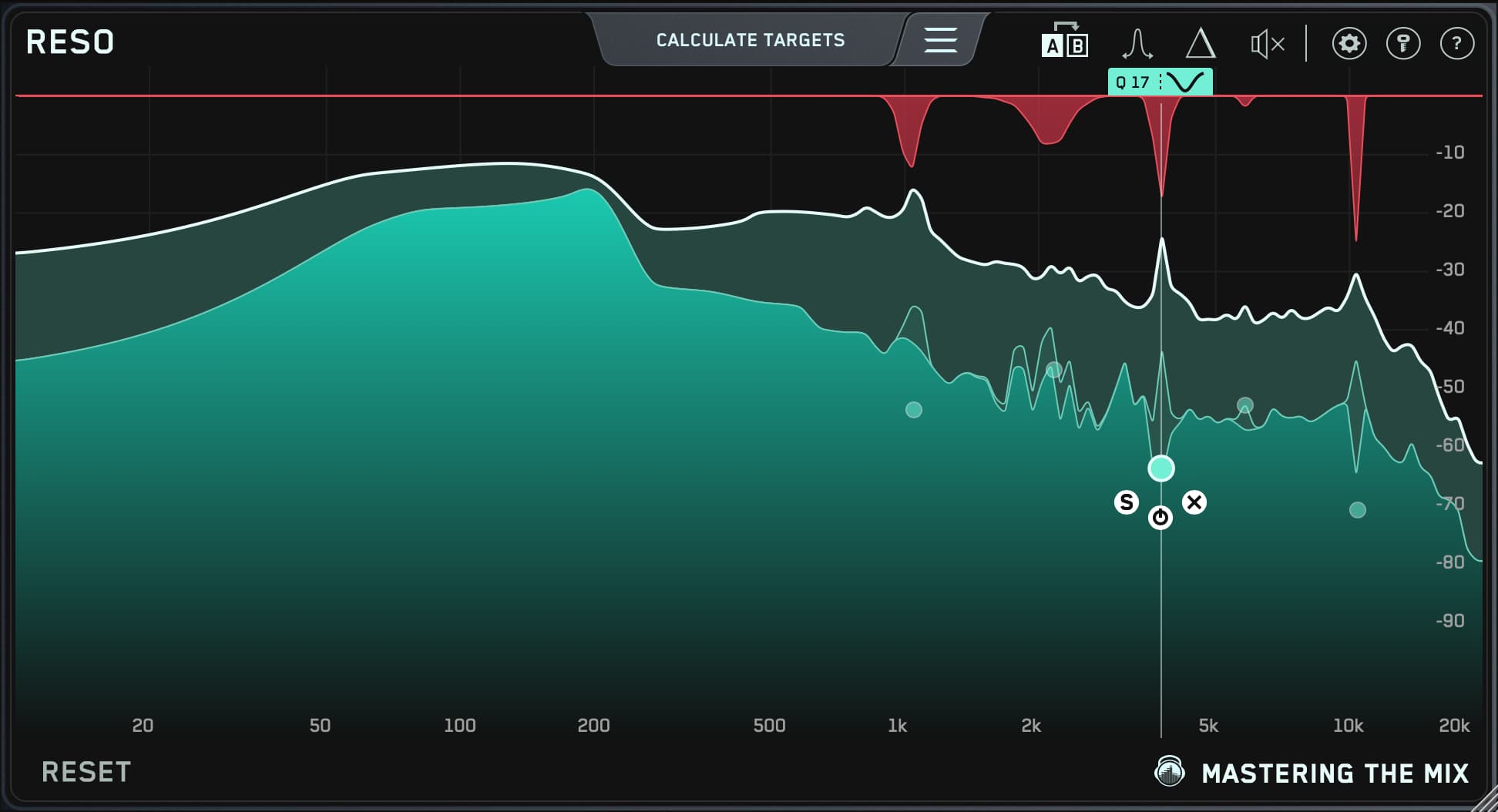
RESO doesn't work like a band-pass de-esser. It listens for resonant peaks at frequencies you've pointed it at, and only ducks them when they cross the threshold you set. You point it at the exact frequency where the harshness lives, set how far it should pull the peak down, and it leaves the rest of the spectrum alone.
Drop a RESO node at 7.2 kHz on a vocal. The breath at 6 kHz stays untouched. The shimmer at 12 kHz stays untouched. The "t" at 4 kHz stays untouched. Only the resonance at 7.2 kHz gets ducked, and only when it pokes above your threshold. The vocal keeps its top end. The "s" stops drawing blood.
This is the same surgical approach RESO uses on a master bus, applied to the much narrower problem that makes a vocal harsh. The post on finding and fixing unpleasant resonances goes deeper on the technique itself if you want background on the dynamic-resonance approach.
RESO is also faster than chasing it with EQ. A static EQ cut at 7.2 kHz would dull every word, sibilant or not. A dynamic node only fires when there's a problem. The vocal sounds normal. Then it would have sounded harsh. Then it doesn't. You only hear the work when the work is needed.
4How To De-Ess Vocals With RESO, Step By Step
This is the workflow. It works on lead vocals, backing stacks, rap, sung pop, country, anything with a microphone capturing a human voice.
- Load RESO on the lead vocal channel. Place it after your broadband EQ but before any compression. The compressor reacts to peaks, and resonant sibilance peaks are usually the loudest thing in the vocal. Tame them first, then let the compressor work on a clean signal.
- Loop the worst sibilant phrase in the song. The chorus is usually a good bet. You want RESO reacting to the actual problem material, not a quiet verse where the "s" never crossed the threshold anyway.
- Find the peak with RESO's frequency sweep. Hold Control and sweep a band slowly from 4 kHz to 10 kHz. The frequency where the "s" stabs hardest is your resonance.
- Drop a node at that frequency. RESO auto-sets the Q based on the frequency, the higher you go, the narrower the band gets. You don't need to set bandwidth manually, just pick the right frequency.
- Set the threshold so the meter shows the node ducking only on the harsh "s" sounds, not on every word. If RESO is reacting to vowels or consonants other than the sibilants, the threshold is too low.
- Set the depth to pull the peak back 3–5 dB on the worst hits. Most vocals don't need more than that. If you find yourself reaching for 8 or 10 dB, the threshold is probably wrong, or you've picked the wrong frequency.
- A/B against bypass. Listen for whether the air, the breath, and the "t" sounds are still intact. RESO's Delta button is also helpful: solo it to hear only what's being removed. If anything other than the "s" is in there, pull the depth back a dB.
- Add a second node only if you have a second peak. Most singers have one. Some have two, one for "s", one for "sh" or "f", separated by a kHz or so. Two narrow nodes will outperform one wide one every time.
5The Two Mistakes That Ruin De-Essing
Most de-essed vocals on tracks that don't quite sound finished have the same problem. The harshness is gone, but the brightness went with it. Here's the difference between the broad approach and the dynamic-resonance approach laid out side by side.
One Wide Band, Ducked Hard
A static or band-pass de-esser pulling 5–9 kHz down by 4–6 dB on every word that triggers it.
What you get:- The "s" stops biting
- The "t" sounds soften and thicken
- Air, breath, and consonant detail all get pulled down
- Vocal sits further back in the mix
- Sounds "fixed" only because the harshness is gone
One Narrow Node, Threshold-Led
A RESO node at the exact resonant frequency, ducking 3–5 dB only when the sibilance crosses threshold.
What you get:- The "s" stops biting
- The "t" sounds stay sharp and present
- Air, breath, and shimmer stay where they were
- Vocal stays forward and bright
- Sounds untouched until the harsh moment, then it just isn't harsh
The other common mistake is putting the de-esser at the wrong stage. After the compressor, the sibilance is already squashed up against the compressor's gain reduction, and you're chasing a problem that's been smeared. Put RESO before the compressor. The only real exception is a vocal chain that's already been bounced and committed, where surgical late-stage repair is the only option.
If your vocal still sounds harsh in the mix after one RESO node and you're tempted to double the depth, stop. Check the EQ first. A 4 dB boost at 5 kHz earlier in the chain will look like a sibilance problem and act like one. The post on EQ-ing vocals to shine without sounding harsh covers the upstream side of this.
De-essing only fixes the resonance at the singer's mouth. If the harshness is coming from the mix bus, a synth stack, a hi-hat, or a guitar in the same frequency range, no amount of RESO on the vocal will help. The piece on fixing harshness in your mix for a smoother sound walks through how to spot which source is the actual problem.

The Top End Was Never The Problem
The top end was never the problem. The resonances were. A vocal that sounded harsh wasn't asking for less air, it was asking for one specific frequency to stop spiking when the "s" hit. Find that frequency. Duck it dynamically. Leave the rest of the top end alone.
Most vocals you mix from now on will need a single RESO node and 3–5 dB of dynamic ducking on the resonant peak. That's it. The "s" stops biting. The breath stays. The shimmer stays. The vocal still feels like it's in the room with you, just without the part that made you flinch.
Frequently Asked Questions
Why do traditional de-essers dull the vocal?
A standard de-esser sees energy in a wide band, usually 5 to 9 kHz, and pulls the whole band down when it crosses a threshold. The harsh ess gets quieter, but so do the breath, air, and consonant detail living in that band, trading harshness for a duller vocal.
What actually causes harsh sibilance in a vocal?
Sibilance is not a band, it is a narrow resonant peak unique to each voice, often only 200 to 600 Hz wide. Bright voices tend to peak around 7 to 8 kHz, chestier voices closer to 5 to 6 kHz, and some singers have a second peak for sh or f sounds.
How do you de-ess with RESO without losing the top end?
Find the resonant peak using RESO's frequency sweep, then drop a node at that exact frequency. It ducks only that resonance, and only when it crosses the threshold, leaving the breath, air, and t sounds untouched. Most vocals need just 3 to 5 dB of ducking.
Where should the de-esser sit in the vocal chain?
Place RESO after your broadband EQ but before any compression. Resonant sibilance peaks are usually the loudest thing in the vocal, so taming them first lets the compressor work on a clean signal rather than reacting to peaks that have already been smeared.