
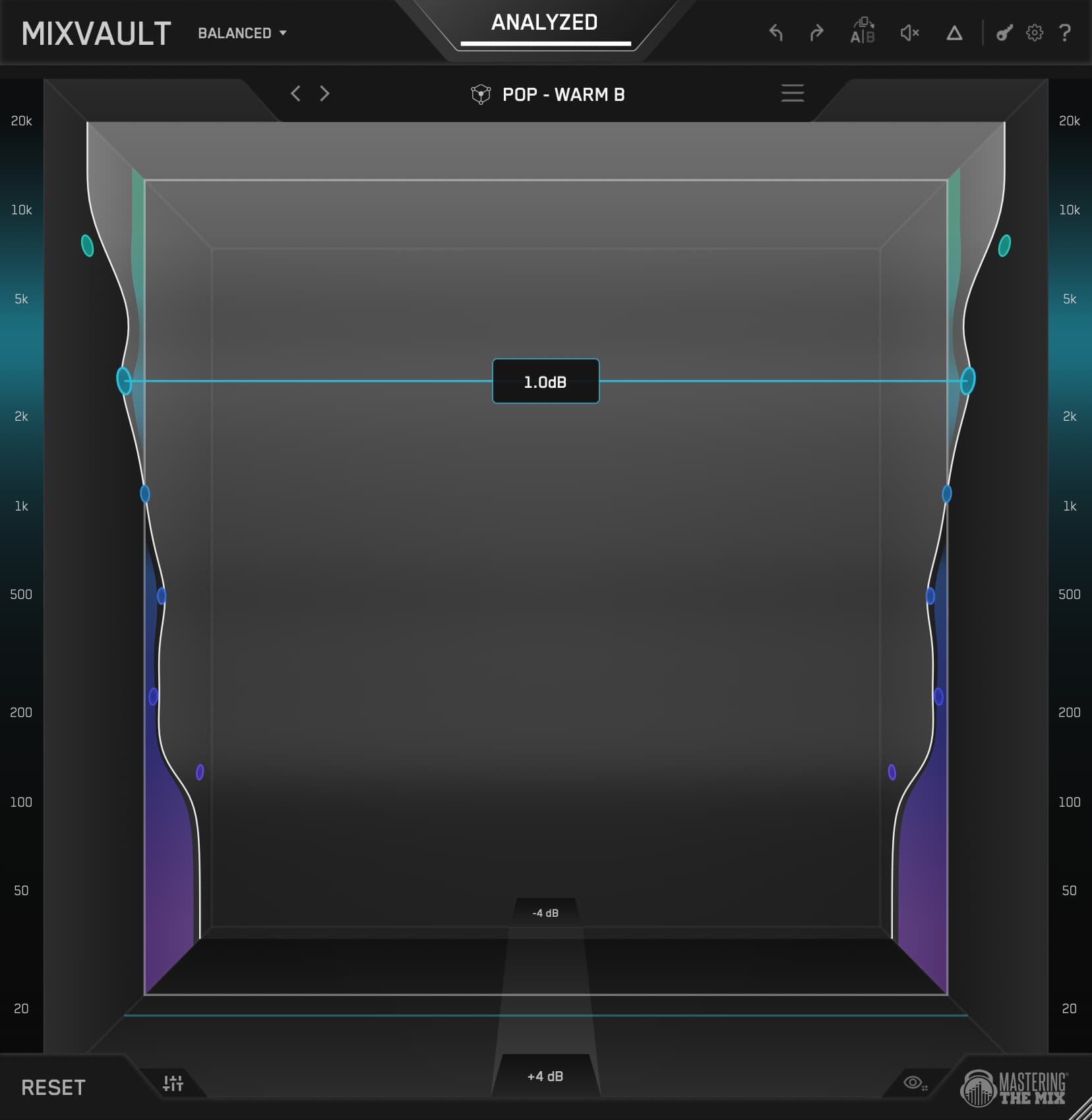

A linear-phase EQ is the most transparent way to shape tone — it never smears your transients. The trade-off has always been latency. MIXVAULT delivers the exact frequency response of a market-leading linear-phase EQ, at its maximum quality setting, with 36× less latency. Here's the measurement, in full.
MIXVAULT was matched to a market-leading linear-phase EQ on an extreme low-end move — a +8 dB low shelf under 100 Hz — and hit the same frequency response within ±0.13 dB. On a transient it produces the same clean, phase-coherent, symmetric response as that EQ's maximum-quality linear-phase mode, but at 41 ms of latency instead of 1,509 ms. Same sound, a fraction of the wait.
1The same frequency response
The comparison only means anything if the EQ curve is genuinely identical, so that's where we started. Both plugins were set to the same measured +8 dB low shelf below 100 Hz and their frequency responses were laid on top of each other. They track within ±0.13 dB across the whole range — close enough that on a real mix you'd never hear a tonal difference between them.

2The result: 36× less latency
With the EQ curve identical, the only things left to differ are behaviour — what each plugin does to a transient — and latency. Here's the headline.

MIXVAULT matches the transparency and quality of a market-leading EQ at its maximum quality setting — at 36× less latency.
3Why transparency matters
Most EQs are minimum phase. They add no latency, but boosting or cutting shifts the phase around the frequencies you touch, which smears the timing of your transients — most audibly in the low end. A linear-phase design keeps every frequency time-aligned, so the move is a pure tonal change with nothing smeared. The catch has always been the latency it costs to get there.
Here's why we care about this so much. Over the years, some of the best engineers in the world — people with rooms most of us only dream about — have messaged us about the filters in BASSROOM and MIXROOM, the plugins MIXVAULT grows out of. It was always some version of the same message: these filters are unreal — what have you done here? They were hearing a transparency they weren't getting elsewhere, and because they were listening on world-class monitoring, they could really hear it.
That's the part that never shows up on a single band. Use a genuinely transparent filter across a whole mix — every channel, every bus — and it stacks up: the mix stays clean, open and true to what you played. Use substandard filters in all those same places and that stacks up too, the other way. Little smears and phase shifts pile on top of each other until everything starts sounding a bit wishy-washy. MIXVAULT is built so that every one of those moves is one of the good ones.
4The test: one kick, one EQ move
To show the difference, we sent a single 2.3 ms pulse — a simplified kick drum — through each EQ with that same +8 dB low-shelf boost, and looked at what came out. In its default Zero Latency (minimum-phase) mode, the leading EQ lets the low end lag the transient: the energy arrives late and trails off to one side, a smeared tail hanging off the back of the hit.

5Linear phase fixes it — at a cost
Switch that same EQ to Linear Phase at maximum resolution and the smear disappears. The response becomes symmetrical — a clean pre- and post-ring around the transient, no lag. But look at the cost: 1,509 ms of latency, 66,560 samples. That's a second and a half of delay for a single EQ, which rules it out for anything but offline work.

6MIXVAULT: the same result at 41 ms
MIXVAULT produces the same clean, symmetric, phase-coherent response — the exact behaviour of that maximum-quality linear-phase mode — at 41 ms of latency and 1,820 samples. Put the two impulse responses on top of each other and the shape is identical. The only thing that's changed is the wait.

Same shape. Same transparency. 41 ms, not 1,509.
7How we measured
For anyone who wants to check the numbers: a FabFilter Pro-Q 3 low shelf (84.3 Hz, +7.80 dB, Q 0.51) was fitted to MIXVAULT's response, with a worst-case deviation of 0.13 dB from 18 Hz to 2 kHz. Both were captured from AU/VST3 builds at 44.1 kHz, and the outputs were latency-aligned for the shape comparison. Pro-Q 3's Linear Phase latency ranges from 70 ms to 1,509 ms depending on the resolution setting; MIXVAULT is fixed at 41 ms.
Both EQs were set to the same measured frequency response before anything else, so the tonal change is held constant and the only variables left are phase behaviour and latency. That's what lets you attribute the difference in the impulse response to the EQ design, not to one simply sounding brighter or louder than the other.
Transparency, proved
MIXVAULT gives you the sound of a maximum-quality linear-phase EQ — the same frequency response, the same clean transient — without the latency that has always made linear phase impractical to work with. It's the transparent low end of a high-end mastering EQ, without the wait.
Try MIXVAULT free and hear it on your own low end.
?FAQ
What's the difference between minimum-phase and linear-phase EQ?
A minimum-phase EQ adds no latency but shifts phase around the frequencies you boost or cut, which can smear transients — most noticeably in the low end. A linear-phase EQ keeps every frequency time-aligned so there's no smearing, but it traditionally adds significant latency. MIXVAULT gives you the clean, phase-coherent result of a linear-phase EQ at a fraction of the usual latency.
How much latency does MIXVAULT add?
41 ms (1,820 samples at 44.1 kHz) for the phase-coherent, transparent low-end response measured here. For comparison, a market-leading EQ needed up to 1,509 ms of latency in its maximum-quality linear-phase mode to reach the same clean result.
Is MIXVAULT really as transparent as a linear-phase EQ?
On this test, yes. Matched to the same frequency response within ±0.13 dB, MIXVAULT's impulse response is the same symmetric, phase-coherent shape as the leading EQ's maximum-resolution linear-phase mode — with no low-end smear.
Which EQ was used in the comparison?
The measurement was made against FabFilter Pro-Q 3, with its low shelf fitted to MIXVAULT's response within 0.13 dB and the outputs latency-aligned. Throughout the post we refer to it as “a leading EQ” because the point is about EQ design in general, not a single product.