

For years, producers have been told one golden rule: keep everything below 100Hz mono. That advice came from a good place. It protects your low-end from collapsing, disappearing, or sounding weak on clubs, phones, earbuds, and mono systems.
But here's the part that doesn't get taught enough: the problem was never width. The problem was bad widening. When the maths is right, you can add controlled width to the low-end and low-mids without wrecking mono compatibility. And when you do it tastefully, your bass can feel bigger, deeper, and more unique without losing punch.

1Why "Keep The Low-End Mono" Became The Rule
Let's start with the uncomfortable truth: most stereo widening tools are risky on bass.
Not because bass can't be wide. Not because anything below 100Hz magically needs to live in the centre forever. But because a lot of traditional widening techniques rely on delay, polarity tricks, phase offsets, or decorrelation that can sound exciting in stereo and then fall apart in mono.
That's where the "keep it mono below 100Hz" rule came from.
Imagine you widen a bass with a simple Haas delay. One side is delayed slightly from the other, so your ears perceive the sound as wider. In stereo, it might feel huge. But when that same signal gets summed to mono, those tiny timing differences can cancel each other out. Suddenly your bass loses weight. The kick feels smaller. The groove doesn't hit as hard.
The low-end is especially vulnerable because long wavelengths carry so much of the physical energy in a track. If the phase relationship is unstable down there, the damage is obvious. You don't just lose "stereo width." You lose power.
So engineers started teaching a safety rule: mono the bass. And honestly, for a lot of tools and workflows, that was the right advice. It stopped beginners from destroying their mixes with one exciting-sounding stereo knob.

But safety rules can become creative limits. The real pro move is not "never widen bass." It's "widen bass in a way that survives mono."
2Naive Widening vs. Phase-Safe Widening
Here's where things get interesting. Two width moves can give you the same apparent stereo spread on a meter, but behave completely differently when collapsed to mono.
A naive widener might create width by delaying one side, flipping polarity, or pushing left/right differences that don't sum cleanly. It sounds wide because your speakers are giving each ear different timing or phase information. The problem is that when left and right are combined, those differences can fight each other.
- Your bass sounds impressive in headphones but weak on speakers.
- Your low-mids feel wide but blurry.
- Your kick and bass relationship changes every time you check mono.
- Your master sounds exciting at first, then strangely hollow everywhere else.
Naive Widening (Haas-Style Delay)
A bass loop run through a classic timing-based widener. Toggle Stereo and Mono while it plays — listen for the bass thinning out and the kick losing weight when the signal collapses.
Phase-safe widening behaves differently. The goal is not just to make the stereo image bigger, it's to preserve the musical information when the signal folds down to mono.
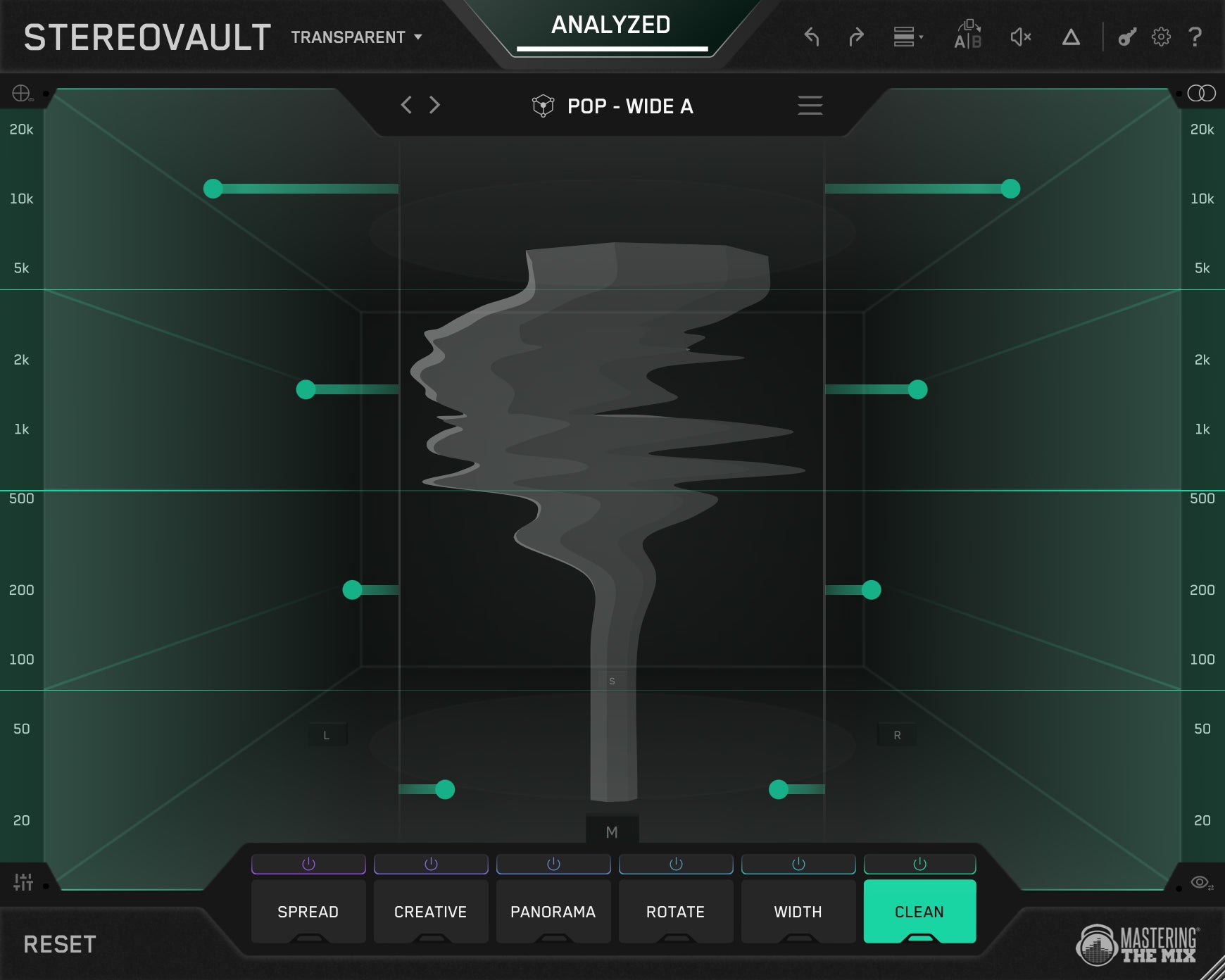
That's why the algorithm matters. In STEREOVAULT, the Diffuse and Vintage options in the Spread tab are designed for widening that keeps the correlation positive, even when pushed. Diffuse uses Gerzon-style per-band allpass diffusion to spread the stereo image smoothly. Vintage uses an Orban-style pseudo-stereo approach, splitting frequency content in a way that can create width from mono or narrow material with a warmer, more coloured character.

That means you're not just turning up "width." You're choosing the physics of how that width is created. And that's the difference between a bass that sounds wide and survives mono, and a bass that sounds wide until it matters.
3The Mono Test That Proves It
This is the test that changes the way you think about low-end width.
Load STEREOVAULT on a bass, bass bus, stem, or full mix. Add a subtle amount of width using Diffuse or Vintage. Then use the output I/O section to set the output to mono. Now bypass STEREOVAULT on and off.

If you've used Diffuse or Vintage properly, the mono signal should stay essentially the same. The tone should hold. The weight should hold. The bass should not vanish, thin out, or change character in a way that makes you panic.
This is what most stereo wideners fail at. They give you the "wow" moment in stereo, then quietly steal the foundation when summed. This test is also brilliant because it's complete objective, you're not relying on theory. You're not staring at a correlation meter hoping everything is okay. I haven't tricked you using audio wizardry... you're hearing the result directly.

The Workflow
- Put STEREOVAULT on your bass channel, bass bus, stem, or master.
- Choose Transparent Mode for mastering, or experiment with Transparent and Flexible Mode when mixing individual channels.
- Go to the Spread tab.
- Position a band around the area you want to widen.
- Try Diffuse for clean, transparent width.
- Try Vintage for warmer pseudo-stereo character.
- Keep the very lowest sub area narrow or untouched at first.
- Use the I/O to monitor the output in mono.
- Toggle STEREOVAULT on and off.
- If the mono low-end stays solid, you're in the right zone.
(It should look like this)
If the processing doesn't change the mono signal but enhances (and improves) the bass in stereo, you've achieved the sweet spot.
Phase-Safe Widening (STEREOVAULT Diffuse)
The exact same bass loop as Example 1. This time widened with STEREOVAULT's Diffuse mode. Toggle Stereo and Mono: the stereo image opens up, but the mono fold-down stays exactly as it was. Same tone and weight.
4Where To Add Width Without Losing Punch
Let's be clear: this is not an invitation to make your entire sub range super wide. You still need balance. You still need punch. You still need the kick and bass to feel locked in the middle. The goal is controlled width, not low-end chaos.
A great starting point is to keep the deepest sub frequencies below around 60–100Hz narrow. This is where the physical weight of the track lives. In club music, hip-hop, pop, and bass-heavy electronic genres, that area usually needs to hit straight down the middle.
The opportunity is often just above that. Try working in the 100–250Hz region for warmth and body, or the 250–700Hz area for bass harmonics, growl, movement, and character. This is where a bass can feel more three-dimensional without making the sub unstable.
- 808s: Keep the fundamental tight in mono, then add a little Vintage width to the upper harmonics so it feels wider on earbuds and laptop speakers.
- Synth bass: Use Diffuse around the low-mids to make the bass feel less like a line in the centre and more like a physical shape in the room.
- Live bass guitar: Widen the texture and fret noise slightly while leaving the low fundamental focused.
- Full master: Use Transparent Mode and add a very small amount of Diffuse above the sub region to give the record more size without changing the core balance.
Don't solo the bass for too long. A width move that sounds dramatic in solo might be too much in the mix. Make the bass feel better in context, then check solo only to understand what changed.
5Diffuse vs. Vintage: Which Should You Use?
Both can work beautifully, but they have different personalities.

Diffuse
Spreads the image smoothly using per-band diffusion. Adds width without sounding obviously processed. Perfect for mastering.
Use when you want:- Cleaner mastering width
- Subtle stereo expansion
- A wider low-mid field without obvious character
- A polished, modern sound
- A safer first move when you're unsure
Vintage
Orban-style pseudo-stereo. Great for creating stereo width from mono or narrow material. Warmer, vibier, more characterful.
Use when you want:- Mono bass to feel more alive
- Flat low-mids to gain movement
- A retro or slightly coloured stereo character
- Width on individual basses, synths, samples or loops
- A more obvious creative effect that still behaves in mono
For mastering, start with Diffuse in Transparent Mode. For an individual bass channel you can experiment. Transparent can be perfect when you want consistency and precision. Flexible can be useful when you want more freedom across different tabs and bands.
There's no single "correct" setting. The right answer depends on the source. The key is to widen with intention, then prove it with the mono test.
Diffuse vs Vintage
Same bass, both algorithms set to a similar perceived width. Toggle between Diffuse (clean, transparent) and Vintage (warmer, more coloured).
6How Far Is Too Far?
The easiest mistake is to discover phase-safe low-end widening and immediately overdo it.
Don't.
Just because a move survives mono doesn't mean it's musically right. Too much width in the low-mids can make a mix feel bloated, unfocused, or emotionally disconnected from the centre. The vocal may feel smaller. The kick might lose authority. The bass might start taking up space that belongs to guitars, synths, reverbs, or background vocals.
Use reference tracks to stay grounded. Load a few commercially released songs in a similar genre into REFERENCE 3 and listen to how the bass compares. Is the sub locked centre? Are the low-mids slightly wide? Does the bass feel huge because of stereo harmonics rather than stereo subs? That's the kind of detail that separates a controlled professional mix from a wide-but-weird one.

Also, check multiple playback systems. Studio monitors will tell you about punch. Headphones will reveal width. Earbuds will expose low-mid clutter. A phone speaker will tell you whether the bass harmonics still translate when the sub disappears.
If widening the low-mids makes the track feel louder, brighter, or more exciting, level-match before deciding. Louder can trick you.
7A Practical Low-End Width Workflow
Here's a simple process you can use on your next track.
Start with your kick and sub relationship. Before adding width, make sure the core low-end is working in mono. The kick should hit clearly, the bass should support the groove, and nothing should feel like it's fighting for the same space.
Next, load STEREOVAULT on your bass bus or individual bass channel. If you're mastering, place it carefully in your chain before final limiting and use Transparent Mode.

Position a band above the deepest sub region. A good starting point is somewhere around 100–300Hz, but use your ears. You're looking for the range where the bass has body and personality, not just pure weight.
Try Diffuse first. Push the amount until you clearly hear the width, then pull it back until you barely miss it when bypassed. That's often the sweet spot.
Then try Vintage. If the bass suddenly feels more alive, more textured, or more memorable, it might be the better choice. If it feels too coloured, go back to Diffuse.
Now hit the mono output test. Bypass STEREOVAULT on and off while listening in mono. If the bass weight and tone hold steady, you've made a phase-safe move. If the low-end changes too much, reduce the amount, narrow the band, or move the processing higher.
Finally, listen in the full mix. The bass should feel wider, but the song should still feel focused. The centre should remain powerful. The groove should not soften.
Width Can Be Safe — When The Maths Is Right
The old advice to keep everything below 100Hz mono helped a lot of producers avoid disaster. But it also made bass width feel forbidden.
It isn't.
The real lesson: don't use widening that creates phase problems. Use widening that survives mono. With STEREOVAULT's Diffuse and Vintage modes, you can experiment with width in the low-end and low-mids in a way that feels musical, controlled, and surprisingly safe. Keep the sub focused, widen the harmonics with care, check the mono output, and trust what the track is telling you.
Try it on your next mix. Add just enough width that the bass feels more alive, then prove it in mono. You might find that the low-end rule you were taught was only half the story.
Try STEREOVAULT →Frequently Asked Questions
Do you really have to keep everything below 100Hz in mono?
Not always. The rule exists because many widening techniques rely on delay, polarity, or phase offsets that collapse in mono and rob the low end of weight. The real problem was never width, it was bad widening. With phase-safe processing you can add controlled width that survives mono.
What is the mono test for low-end width?
Load STEREOVAULT on the bass or mix, add a subtle amount of width with Diffuse or Vintage, then set the output to mono and bypass on and off. If the mono tone and weight hold steady, the move is phase-safe. If the bass thins or changes character, pull back.
Where should you add width to bass without losing punch?
Keep the deepest sub, roughly below 60 to 100Hz, narrow and centred, since that carries the physical weight. Add width just above, around 100 to 250Hz for warmth or 250 to 700Hz for harmonics and character, where the bass can feel three-dimensional without destabilising the sub.
What is the difference between Diffuse and Vintage for bass width?
Diffuse uses per-band allpass diffusion to spread the image cleanly and transparently, making it ideal for mastering. Vintage uses an Orban-style pseudo-stereo approach that creates width from mono or narrow material with a warmer, more coloured character, better suited to individual bass channels.