

Two different things drain energy from a mix, and most producers can't separate them. Resonant peaks that mask the rest of the track. Phase cancellations that subtract frequencies before they ever reach the listener. Both are hidden, both kill perceived loudness, and both are why your mix often sounds quieter than commercial records at the same LUFS, even after a limiter has done everything it can.
This post covers six hidden frequency problems that drain energy from most mixes, what each one sounds like, and how to fix them with RESO and FUSER. RESO catches the resonances. FUSER handles the phase cancellations. Together they recover energy you didn't know you were losing.
Hidden Frequencies. Bypass And With RESO.
Toggle Bypass and With RESO while it plays. Listen for the resonances getting caught and the rest of the signal opening up at the same level. The fixed version isn't louder. It's clearer, fuller, and more present.

1The Boom Note On The Bass
What it sounds like
One specific note on the bass jumps out louder than the rest. The boom note. Often the open low E, sometimes the A, sometimes whichever pitch happens to line up with a body resonance. Most producers reach for a static EQ cut, but a fixed cut thins every other note that uses that same range. The bass goes thin overall while you're trying to fix one problem note.
The move
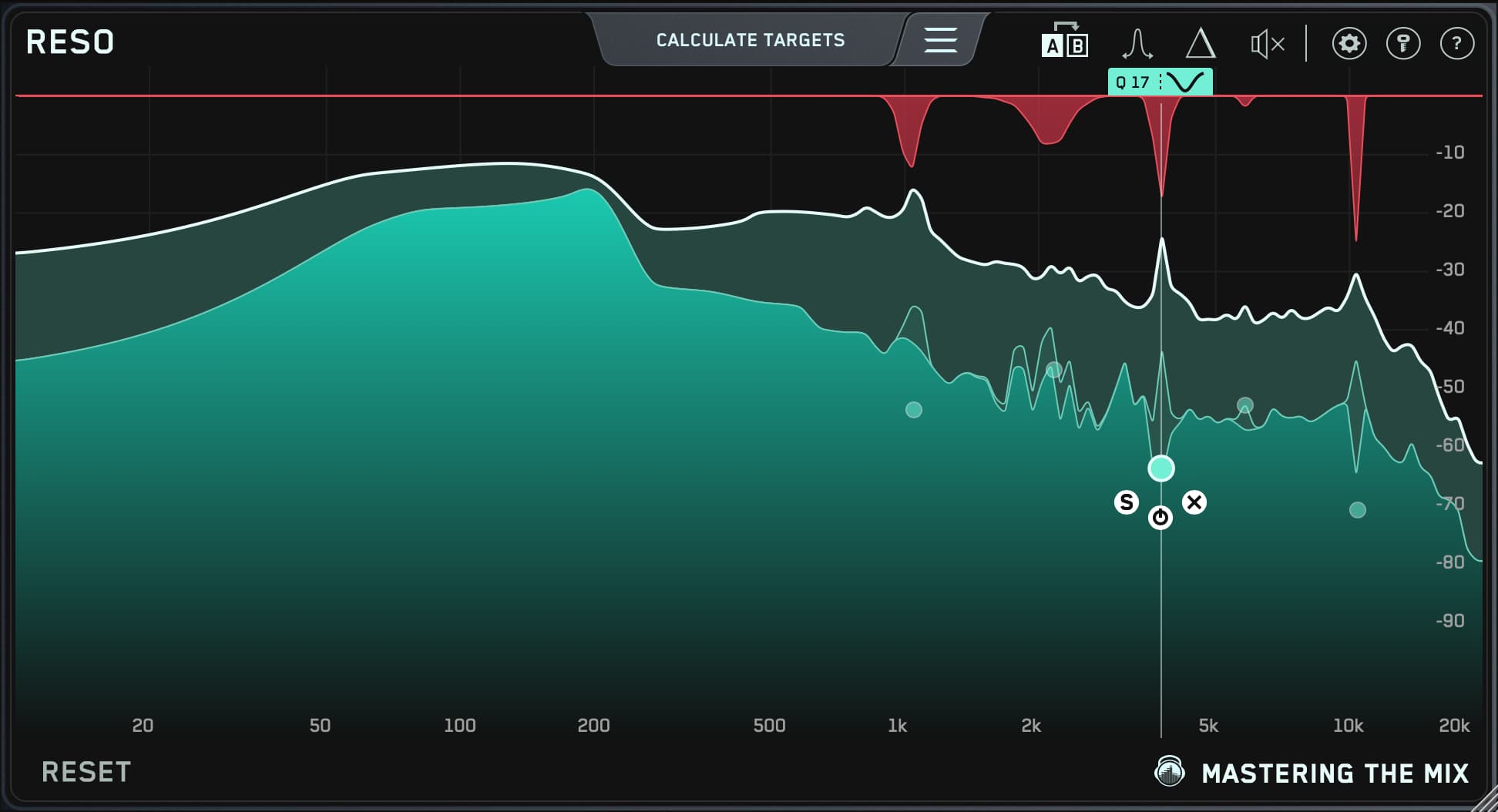
RESO does this dynamically. It listens for the resonant peak at the frequency you point it at and only ducks when it crosses threshold. The boom note triggers the duck. The other notes don't. Drop a node where the boom note hits (most often around 80, 110, or 140 Hz on bass guitar), set the threshold so only the loud note crosses it, and pull the depth back 3 to 5 dB.

Energy recovered: the bass register stops being dominated by one note, so the rest of the bass actually shows up. Choruses that felt uneven start landing the way you wrote them.
2Resonant Peaks On The Lead Vocal
What it sounds like
The vocal is fine on most of the take, then occasionally gets piercing or nasal on a specific note, vowel, or consonant. Plays back fine on monitors. Stabs on earbuds. Static EQ cuts kill the vocal's life because the offending frequency only exists for a fraction of the take.
Vocal Resonances. Bypass And With RESO.
Same vocal, level matched. Toggle Bypass and With RESO while it plays. Listen for the piercing notes losing their stab while the rest of the vocal stays present and full.
The move
RESO with multiple nodes across the vocal range. Hold control and sweep slowly from 1 kHz to 8 kHz to find resonance peaks. Common spots: nasal honk around 1 to 2 kHz, harsh consonants at 3 to 5 kHz, sibilance at 6 to 8 kHz. Drop a node at each one, set the threshold so the node only ducks when that specific frequency spikes, depth 2 to 4 dB. The vocal stops poking out on troublesome notes without losing presence on the rest. The post on finding and fixing unpleasant resonances covers the sweep technique in more detail.
Energy recovered: vocals you don't have to ride at the chorus. The lead sits forward without anyone needing to pull a fader.

Nicki Minaj, Sean Paul, Sam Feldt
"Rarely I'm trying new products and get the wow factor, but THIS IS F**KING IT! Finally a tool that I actually need, great job Mastering The Mix!"
Try RESO free →3The Snare Ring In The Low-Mids
What it sounds like
The snare has a long sustained tone in the 200-400 Hz range that didn't bother you on the original take but rings through every chorus once the mix builds up. Masks the kick's low-mid body. Makes the whole mix feel boxy without you being able to point at why.
The move
Loop a couple of bars of the chorus on the snare or drum bus. Sweep a band slowly through 200 to 500 Hz with RESO. The ring will jump out at one specific frequency, often around 240 or 320 Hz. Drop the node there, set the threshold so only the ringing peak crosses it, depth 3 to 4 dB. The snare keeps its body, the ring stops smearing into the kick's range, and the low-mids open up.
Energy recovered: kick weight that was being masked, and the mix loses that boxy quality you couldn't quite name.
4Kick And Bass Phase Cancellation Below 100 Hz
What it sounds like
The kick is there. The bass is there. The combined low-end feels less punchy than either element on its own. Worse on small speakers. Worse in mono. The low-end is the part of the mix that should hit hardest, and it's hitting softest. This is the single biggest hidden-frequency problem in modern productions, and most producers don't know to check for it.
Kick And Bass. Bypass And With FUSER.
Same kick and bass loop, level matched. Toggle Bypass and With FUSER while it plays. Listen for the kick and bass locking into one unified low-end once phase optimization is doing its work.
The move
FUSER's Automatic Phase Optimization fixes this in seconds. Load FUSER on the bass, sidechain the kick, click Automatic Phase Optimization. The plugin scans the relationship between the two signals and applies the phase rotation that gives you the strongest summed low-end. A/B against bypass and the low-end gets perceptibly louder without you raising any faders.
Phase cancellation is the heaviest hidden frequency issue in the list because it doesn't sound like a problem. Resonances poke out, so producers eventually notice them. Cancellations are the opposite. The frequency just isn't there. You can spend hours pushing the kick fader trying to find the punch, when the punch is already in the recording, just being subtracted. Optimize the phase once and the punch comes back without any other change.

Energy recovered: low-end weight that was cancelling silently before. The kick and bass start feeling like one unified low-end event instead of two competing ones. The post on getting a bass guitar to sit in the pocket covers the full FUSER workflow if you want to go further.
5Cymbal And Hi-Hat Sizzle Ringing
What it sounds like
The cymbals and hi-hats have a piercing top-end ring that builds across the chorus. The first hit is fine. By the eighth hit, the top end is fatiguing. Lower the cymbal level and the kit loses energy. Cut the high frequency with a static EQ and the cymbals lose their character.
The move
RESO with a node in the 5 to 9 kHz range, threshold set so it only ducks when the sizzle stacks above a peak threshold. Single hits stay bright. Repeated hits stop building. The kit keeps energy without the listener fatigue.
This one matters more than producers think. Top-end fatigue is one of the main reasons listeners turn down a track or skip it, and producers often misdiagnose it as the mix being too loud. The mix isn't too loud. The cymbals are stacking energy in a narrow range and the listener's ear is reacting to that, not the overall level.
Energy recovered: the chorus stays exciting on the eighth bar instead of becoming exhausting. Important for tracks that get played at volume in cars or on monitors, where high-frequency build-up is most punishing.
Click the small Delta triangle on any RESO node to solo what RESO is removing. You should hear a clear hit on the offending note, vowel, or transient, not a wash of the whole signal. If the Delta sounds like the whole vocal or the whole drum bus, the node is too wide or the threshold is too low. The Delta is the fastest way to confirm RESO is doing surgical work, not broad work.
6The 200-500 Hz Mud Build-Up Across The Mix
What it sounds like
Each element sounds fine in solo. Combined, the mix feels muddy in the low-mids. No single track is the obvious culprit. This is mass build-up: ten elements each contributing a small amount of energy in the same range, and together they smother the mix.
Rock Mix. Bypass And With FUSER.
Full rock mix, level matched. Toggle Bypass and With FUSER while it plays. Listen for the low-mids opening up as the mass build-up gets resolved across the elements that are stacking energy in the same range.
The move
RESO on the mix bus, with nodes scanning the 200 to 500 Hz region. The dynamic nature is what makes this work. A static EQ cut would thin every chorus where the low-mids are actually fine. RESO only ducks when the build-up exceeds threshold, so the verses and quieter sections stay full. Set the thresholds so the nodes barely engage on the verses and pull 2 to 3 dB on the choruses where the mass is actually a problem.
Energy recovered: clarity in the low-mids without losing weight elsewhere. The post on fixing channels fighting for space covers the mix-side approach to this same problem if you want to address it earlier in the process.
A limiter raises the level of everything, including the resonances and the cancellations. Tame the resonances first and the limiter has less to fight against. Fix the phase cancellations first and the low-end already hits before any compression happens. The same mix at the same LUFS sounds louder and clearer because the energy is in the right places. That's the difference between mixes that translate and mixes that just get louder.
The Mix You Wrote Is In There. RESO And FUSER Get It Out.
Most producers spend the last hour of mixing pushing the master limiter, hoping for energy that isn't going to come from a limiter. The energy is already in the mix. It's hidden behind resonances that are masking the rest of the track and phase cancellations that are subtracting frequencies before the listener hears them. RESO and FUSER find both kinds and clear them out.
Run RESO on the bass, the lead vocal, the snare, the cymbals, and the mix bus. Run FUSER on the bass with the kick sidechained. The whole pass takes maybe 20 minutes once you've done it a few times. The result is a mix that has the energy you wrote in the first place, audible at the level you're already mastering to.
Frequently Asked Questions
What two hidden problems drain energy from a mix?
Resonant peaks that mask the rest of the track, and phase cancellations that subtract frequencies before they reach the listener. Both are hidden and both reduce perceived loudness, which is why a mix can sound quieter than commercial records at the same LUFS.
How does RESO fix a boom note without thinning the bass?
A static EQ cut thins every note sharing that range. RESO works dynamically, listening for the resonant peak and ducking only when it crosses threshold. Drop a node where the boom note hits, often around 80, 110, or 140 Hz, so only the loud note triggers a 3 to 5 dB reduction.
How do you recover low-end lost to kick and bass phase cancellation?
Phase cancellation does not poke out, the frequency just is not there, so producers push the kick fader for punch that is being subtracted. Load FUSER on the bass, sidechain the kick, and click Automatic Phase Optimization to apply the rotation that gives the strongest summed low-end.
How do you tame cymbal and hi-hat sizzle that builds up?
Top-end fatigue is often misdiagnosed as the mix being too loud. Place a RESO node in the 5 to 9 kHz range with the threshold set so it only ducks when the sizzle stacks above it. Single hits stay bright while repeated hits stop building, keeping the chorus exciting.